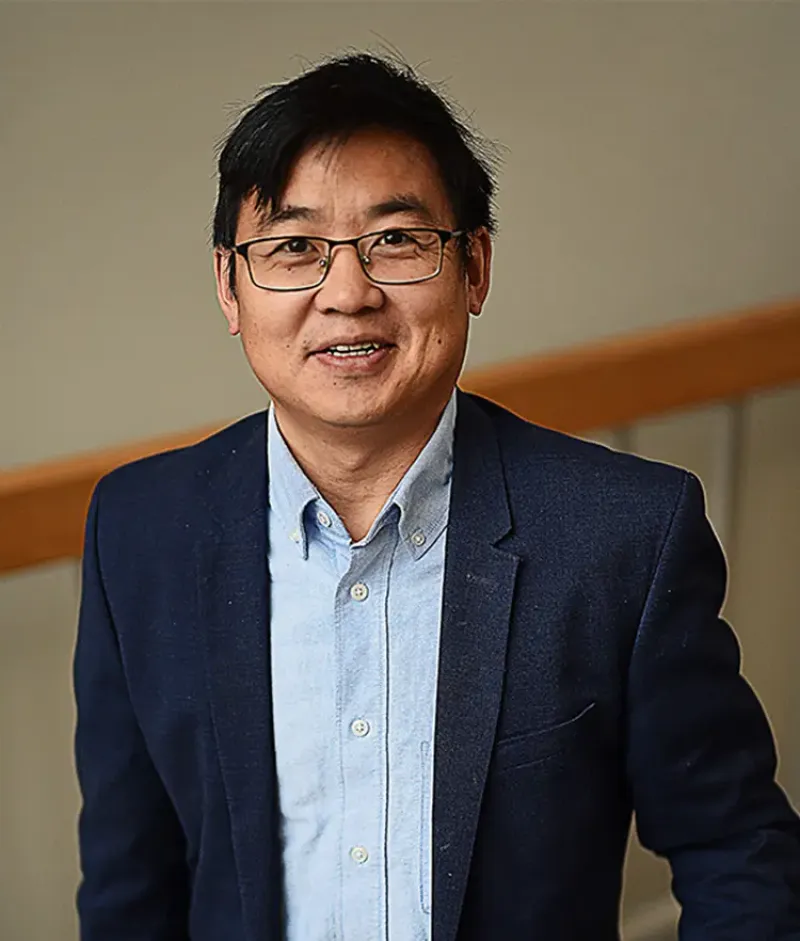
Bin Chen , PhD
Biography
I am a tenured associate professor leading a multidisciplinary lab, with a mission to leverage advanced machine learning and emerging big data to discover new therapeutics. I am also the Founding PI of the Center for AI-Enabled Drug Discovery in the College of Human Medicine at MSU. My current research areas include machine learning method development, integrative bioinformatics, and EHR mining. I have training in informatics, chemistry, and biology, and working experience in big pharmaceutical companies and small startups. As a corresponding author, I have published in many high-profile journals such as Cell, Nature Protocols, Nature Reviews Gastroenterology & Hepatology, Nature Communications, Cell Systems, Genomics, Proteomics & Bioinformatics, and Briefings in Bioinformatics. As a PI/co-PI, I have received a K01 career training award, multiple R01-level NIH grants, industry-sponsored grants, and foundation grants, totaling over $7 million. I have served as a mentor/co-mentor for two K99 training grants and have mentored four trainees who have gone on to become PIs. In the next few years, I aim to pioneer transcriptomics-based drug discovery, develop foundational models to understand how individual cells respond to perturbations, and utilize massive real-world data to assess drug efficacy.
Employment
Assistant/Associate Professor, Michigan State University, Grand Rpaids, 2018 - Present
Instructor/Assistant Professor, University of California, San Francisco, San Francisco, 2015 - 2018
Publications
Molecular Lead Optimization via Agentic Tool Planning (2026)
Liver Metastasis Risk and Timing in Pancreatic Cancer Patients Using Electronic Health Records (2025)
Large-scale information retrieval and correction of noisy pharmacogenomic datasets through residual thresholded deep matrix factorization Briefings in Bioinformatics (2025)
STANCE: a unified statistical model to detect cell-type-specific spatially variable genes in spatial transcriptomics Nature Communications (2025)
Imputing abundance of over 2,500 surface proteins from single-cell transcriptomes with context-agnostic zero-shot deep ensembles Cell Systems (2024)
TransCell: In Silico Characterization of Genomic Landscape and Cellular Responses by Deep Transfer Learning Genomics, Proteomics & Bioinformatics (2024)
Computational discovery of co-expressed antigens as dual targeting candidates for cancer therapy through bulk, single-cell, and spatial transcriptomics Bioinformatics Advances (2024)
OCTAD: an open workspace for virtually screening therapeutics targeting precise cancer patient groups using gene expression features Nature Protocols (2021)
Harnessing big ‘omics’ data and AI for drug discovery in hepatocellular carcinoma Nature Reviews Gastroenterology & Hepatology (2020)