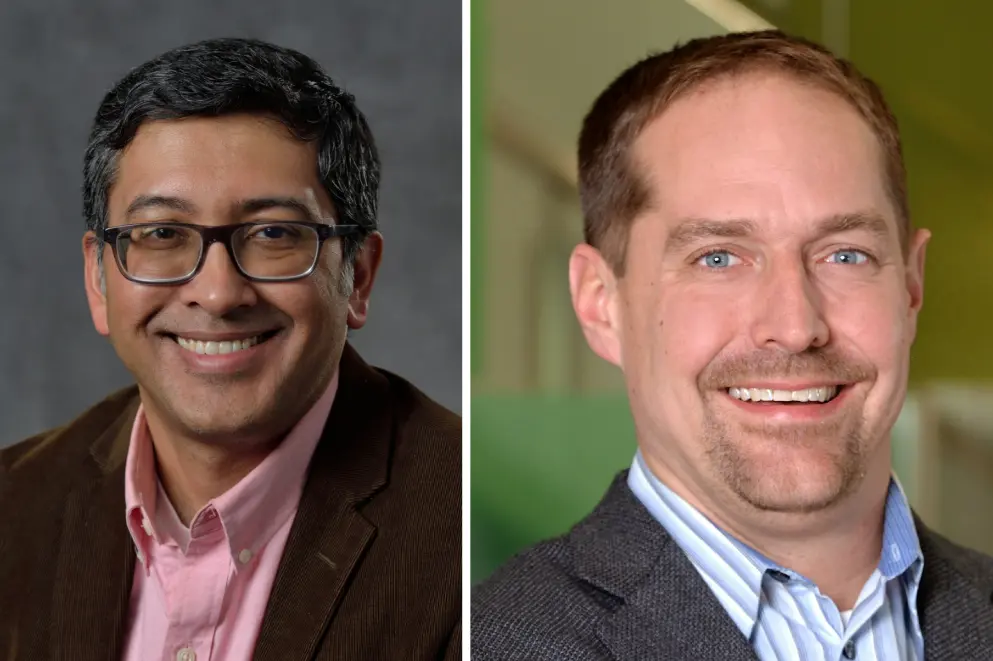
Sudin Bhattacharya , PhD
Biography
Dr. Sudin Bhattacharya (he/him/his) is an Associate Professor in the departments of Biomedical Engineering and Pharmacology & Toxicology. He leads a lab that conducts research at the interface of computation and biology, using quantitative tools to study the signaling and transcriptional networks that regulate cell fate and its perturbation by environmental pollutants. Dr. Bhattacharya joined MSU as an assistant professor in November 2015. Originally from Kolkata, India, he completed his undergraduate degree at Jadavpur University in India, his master’s degree at the University of Kentucky, and his Ph.D. at the University of Michigan, all in mechanical engineering. He completed his postdoc in computational biology at The Hamner Institutes in Research Triangle Park, North Carolina.
Education
PhD, Mechanical Engineering, University of Michigan, 2006
MS, Mechanical Engineering, University of Kentucky, 1999
Employment
Associate Professor , Michigan State University, East Lansing, 2023 - Present
Assistant Professor, Michigan State University, East Lansing, 2017 - 2023
Assistant Professor, Michigan State University, East Lansing, 2015 - 2017
Research Investigator, The Hamner Institutes for Health Sciences, Durham, 2009 - 2015
Publications
Protocol for predicting single- and multiple-dose-dependent gene expression using deep generative learning STAR Protocols (2025)
Unique challenges and best practices for single cell transcriptomic analysis in toxicology Current Opinion in Toxicology (2024)
A cell atlas of thoracic aortic perivascular adipose tissue: a focus on mechanotransducers American Journal of Physiology-Heart and Circulatory Physiology (2024)
Perivascular Adipose Tissue Remodels Only after Elevation of Blood Pressure in the Dahl SS Rat Fed a High-Fat Diet. Journal of vascular research (2023)
A patterned human primitive heart organoid model generated by pluripotent stem cell self-organization Nature Communications (2023)
Interpretable predictive models of genome-wide aryl hydrocarbon receptor-DNA binding reveal tissue-specific binding determinants Toxicological Sciences (2023)
Generative modeling of single-cell gene expression for dose-dependent chemical perturbations Patterns (2023)
Prediction of mammalian tissue-specific CLOCK–BMAL1 binding to E-box DNA motifs Scientific Reports (2023)